
From Vineyard to Doorstep: A Wine Lover’s Guide to Tasting and Gifting

Share

From Vineyard to Doorstep: A Wine Tasting and Gifting Guide
Everyone who likes wine has made this mistake once. You drink something extraordinary on holiday — a chilled red on a terrace in Piedmont, poured by the man who grew it — and carry a bottle home in your hand luggage like a relic. Then you open it on a wet Tuesday in Guildford and it’s just… fine.
The wine hasn’t changed. The terrace has. Which is the first useful thing to understand about drinking well: context does most of the work. The pleasure is in where you were, who poured it, and what you ate alongside it.
Which is why tasting and gifting belong in the same conversation. Both are attempts to hand someone a moment rather than a liquid.
Where to Taste: Regions Worth the Journey
Wine tourism is quietly one of the best-value holiday formats going. Producing regions are rural, beautiful and obsessed with food — and a fraction of the cost of a comparable city break. The classics earn their reputation:

- Champagne, France — 90 minutes from Paris by train, and the only place on earth where the pressure inside a bottle is a tourist attraction. Go in September for harvest.
- Rioja, Spain — startling modern architecture dropped into medieval villages, and the most generous tasting-to-price ratio in Europe.
- The Douro Valley, Portugal — terraced hillsides, river boats, and port houses run by the same families for two centuries.
The Same Logic Applies to Spirits
Distillery trails are often better organised than vineyards. Speyside packs 50-odd working distilleries into a short drive; the Kentucky Bourbon Trail formalises a route through the distilleries that built American whiskey, with a walkable version in Louisville for anyone who’d rather not drive; and Yamazaki and Hakushu are both within reach of Kyoto, if you book months ahead.
If a trail leaves you wanting to keep exploring at home, bourbon and whisky collections are usually easier to browse online than to hunt down in a British supermarket.
The Long-Haul Detour Nobody Expects
Everything above is a short flight or a train ride. But the region most likely to surprise a British drinker isn’t in Europe at all.
India has a real wine country, and almost nobody here knows it. Nashik sits three hours inland from Mumbai, at an altitude and on a volcanic soil that produce Sauvignon Blanc and Shiraz capable of embarrassing a fair few European bottles. The industry is young — most of it built since the late 1990s — but it grew up around visitors rather than exports.

Why it’s worth the detour:
- It’s built for tasting. Vineyard stays, proper tasting rooms, restaurants on site and a harvest festival, rather than the by-appointment culture of some old-world estates.
- The season is inverted. Harvest runs February to March — precisely when a British winter makes the idea appealing.
- It doesn’t need its own trip. Nashik slots into a Rajasthan or Golden Triangle route as a two-day detour, and a flight of six wines costs less than one glass in Napa.
How to Taste Once You’re There
Tasting rooms intimidate people unnecessarily. Nobody is testing you, and the person pouring would rather talk to someone curious than someone performing expertise. What helps:

- Ask what they drink at home. The best question in any tasting room, and it gets a more honest answer than “what’s your best wine?”
- Use the spittoon. It isn’t rude — it’s the whole reason it’s there. Six wines swallowed before lunch and you’ll remember none of them.
- Taste light to heavy, dry to sweet — unless the winemaker suggests otherwise, in which case they have a reason.
- Write one line per wine — not tasting notes, just what you’d say to a friend.
- Buy one bottle you loved, not six you might.
Above all, don’t be reverent. Wine is ruined by solemnity more often than by bad decanting — as we’ve argued before, pizza and champagne is a genuinely great pairing, and the same permission applies in a tasting room.
Getting It Home
Here’s where enthusiasm meets baggage allowance. Arriving in Great Britain, your personal allowance is more generous than most travellers assume:
- 18 litres of still wine — around 24 standard bottles
- 42 litres of beer
- Plus either 4 litres of spirits (over 22% ABV) or 9 litres of sparkling or fortified wine, and you can split that final category proportionally
One catch: go over in a category and you pay duty on everything in it, not just the excess. It’s per person, so a couple travelling together doubles it.
Beyond the paperwork:
- Check a bag. Liquids over 100ml can’t clear security, and duty-free bought airside on a connecting flight is regularly confiscated at the transfer.
- Pack bottles in clothing, in the middle of the case — one at the edge is one you’ll be apologising to your shirts about. Or ask the producer to ship: dearer than excess baggage, but nothing breaks.
- Open it soon. Wine bought for the memory should be drunk while the memory is fresh. If you’re buying to keep, our guide to building a wine cellar on a budget is a sensible place to start.
The Border Problem: Why You Can’t Just Post a Bottle
The best part of coming home with good wine is handing some of it to other people. The complication arrives when those people live abroad, and the instinct is to post a bottle. Don’t — it almost never works, and the reasons stack up:
- Postal services restrict alcohol internationally, so the parcel is refused at the counter or removed in transit.
- Couriers accept it only from licensed businesses enrolled in their alcohol programmes, which need a trade account and export credentials no individual holds.
- Anything that does get through can land your recipient with duty worth more than the gift.
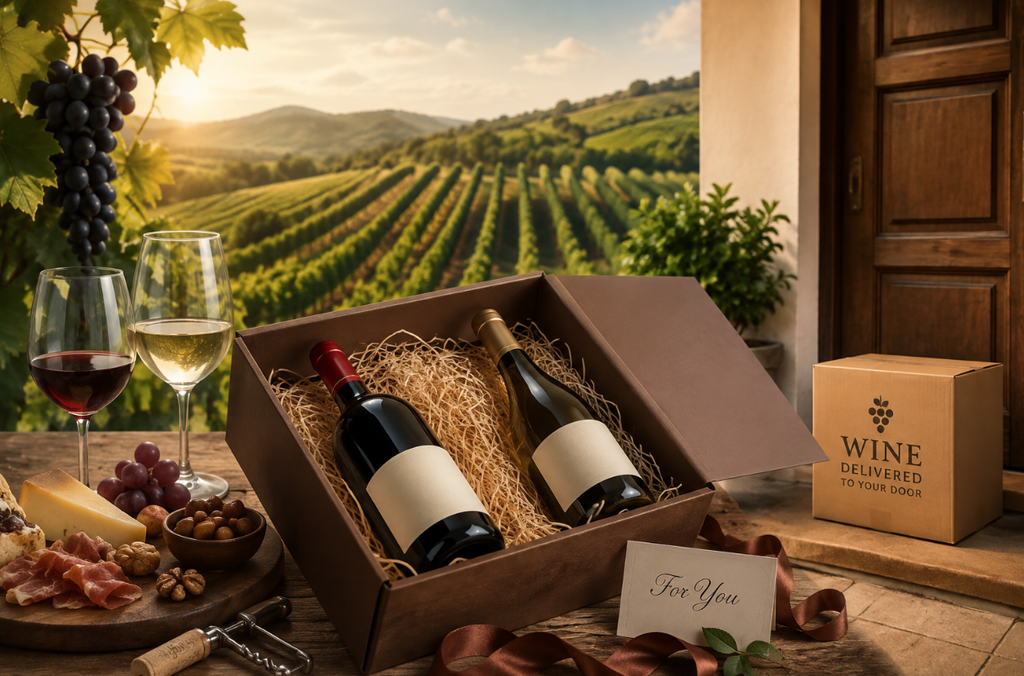
The workaround is simple once you know it. Rather than shipping across a border, order from a specialist that already holds stock in the recipient’s country and delivers domestically. For the most common case — someone in the United States — services built to send wine gifts from the UK to the USA treat the order as a domestic American delivery. No customs stage, no duty surprise, no three-week wait. You pay here; it arrives there, usually within days.
It’s the same logic as sending flowers abroad: you don’t post tulips to New York, you ask someone in New York to make the arrangement.
Choosing Something Worth Opening
Once logistics stop being the problem, the gift becomes the interesting part:
- Match the register to the moment. Champagne for achievements, a good red for a dinner invitation, something aged for a milestone birthday.
- Mind the signature rule. Alcohol deliveries require an adult signature, so a workplace address often beats a home one during office hours.
- Order early. Five to seven days in peak periods.
And a pairing almost always beats a lone bottle: wine with cheese, chocolate or charcuterie turns a gift into an evening rather than a shelf item, which matters most for corporate or less-familiar recipients. This run-through of wine gift basket ideas for any occasion is a useful shortcut if you’d rather not build one yourself.
Weddings, Where a Generic Bottle Underperforms
Weddings are the exception to most gifting advice, because couples receive a great deal of wine and remember almost none of it.
What survives is the thing with their names on it: the engraved flutes brought out on every anniversary, the dated cake knife, the bottle kept unopened until a birthday that matters. Timing counts too — if you can’t attend, send it before the day, while the couple still have the attention to notice it.
It’s the one occasion where paying for personalisation is straightforwardly worth it, and where wedding gifts made for the couple rather than the registry outlast the first house move.
Frequently Asked Questions
Do I need to know about wine to enjoy a tasting?
No. Curiosity is worth more than vocabulary — asking what the person pouring drinks at home gets you further than any terminology.
How far ahead should I order a gift for delivery abroad?
Five to seven days over Christmas and Valentine’s; two to three days is usually enough the rest of the year.
The Thread Running Through All of It
Wine rewards attention far more than money. The bottle you remember is rarely the expensive one — it’s the one attached to a place you stood, a person who explained it, or a moment somebody chose to mark by sending it to you.
So go to the regions, including the ones nobody puts on the list. Buy the bottle you actually loved and open it while the trip still feels close. And when someone you care about is celebrating four thousand miles from your kitchen table, send them something real instead of a message.
The terrace can’t be posted. Everything else can be arranged.

