Student Academic Policies in 2026: AI Rules, Fit to Sit & Digital Exams Explained

Share

Student Academic Policies in 2026: The New Rules on AI, Fit to Sit and Digital Exams
This article shares the key pillar of the student academic administration that has been introduced in the modern academic world of 2026. Keep reading to learn all the knitty-gritty of all these policies.
As we step into 2026, traditional student academic policies have been rewritten to meet the higher standards of today’s rapidly changing educational world. Now, artificial intelligence is no longer an unfamiliar concept but a standard tool used under the strict new integrity guidelines. Beyond the tech, the introduction of the ‘Fit to Sit’ policy in the student academic administration has also transformed our approach to evaluating mental health and testing.
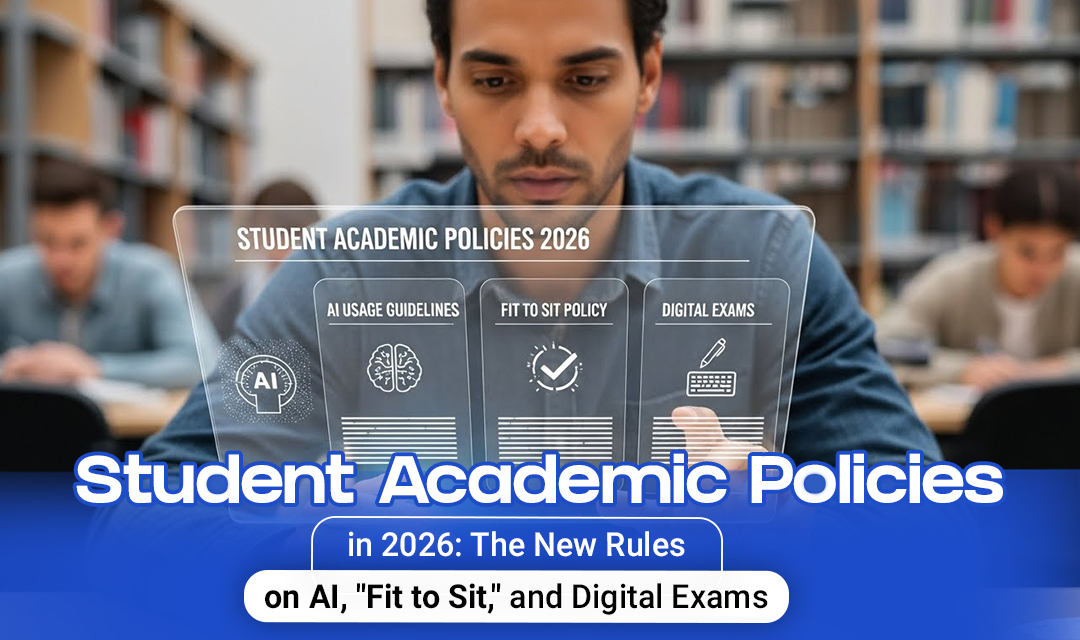
This policy forces students to take personal responsibility for their well-being before entering the exam hall. On the other hand, the initiation of the digital exams has officially replaced the old pen-and-paper era. Whether you are a first-year student or finishing your degree, understanding these new administration policies is important for success. In this article, we will share the three most critical changes to students’ academic policies in 2026 that are important to know to achieve success.
Points to Remember:
- In today’s modern academic world, traditional student academic administration has transformed to meet the higher educational standards.
- The right use of generative AI, the fit-to-sit rule, and the digital identity are the cornerstones of modern academic policies.
- The universities do not follow the traffic light system for the right use of the generative AI tools.
- Students must know the protocols about the fit-to-sit rule and ensure that they don’t breach any academic rules.
- The introduction of the digital world makes sharing and storing academic credentials easy for students.
Academic Integrity and Generative AI Policies
In today’s digital world, AI has integrated into almost every aspect of life, including the education system. It has now become impossible to cut off the complete use of the AI, so the student academic administration typically follows a general principle. According to this rule, generative AI can be used to learn intricate concepts, but cannot be used to create falsified work.

In simple words, AI can support your learning, enhance your ability to achieve the desired outcomes, and prepare you to achieve academic success. But using the AI to create false work can damage your learning, and also be considered academic misconduct.
The University of Leeds introduced a three-layered light system to show the best way to use AI in assessments. Check out what this system is.
- Red – AI cannot Be Used in Any Case.
The assessments that fall under this category must be invigilated strictly to ensure that there is no use of generative AI. The best examples of these tests are class tests, lab experiments, in-person examinations, assignments, essays, and other written tasks. The key purpose of these assessments is to develop foundational learning skills, such as remembering, understanding, and polishing critical skills.
During these assessments, students can ask their mentor or professor for clarification, but cannot use any AI tool. Students can also hire professional essay writing services to get assistance from their expert writers, who can complete the essays without using any AI tool.
- Amber – AI Can Be Used for Learning Purposes
Student’s academic administration allows the use of generative AI for those assessments that fall under this category, but only in the case of an assistive role. That means AI tools can be used for the improvement of particular skills only in a specific way. For instance, students can use the AI tool for data analysis or pattern recognition.
- Green – AI Should Be Used as Part of the Assessment
The green category is the main highlight of this traffic light system. The AI is the primary tool for the completion of the assessments that come under this category. The key purpose of these assessments is to demonstrate the ability to use artificial intelligence tools effectively and mindfully to solve complex problems.
Exams and Assessment: The “Fit to Sit” Rule

The next key pillar of student academic administration is the ‘Fit to Sit’ rule. According to this rule, students who appear in the examination hall are presumed to be fit to sit the exam. The entire assessment is conducted based solely on the performance on the exams, and the personal circumstances cannot affect the exam results.
Once the student appears in the exam hall, they are presumed to be fit, and no special arrangement is provided to them. If a student is unwell or facing any unforeseen circumstances that prevent them from appearing in the exams, then they must notify the institution via email or other official means.
Students must follow this fit-to-sit rule on the exam day to ensure:
- The smooth execution of the exam
- No candidate gets disturbed
- The integrity of the examination hall is being protected
Your Digital Identity: Transcripts and Records

With the advancement of the education system, the academic identity of students also transitioned into a controllable and portable format. The centre of this shift is the Learner Wallet that offers a seamless platform to students where all their academic achievements are stored as academic assets.
Unlike traditional identity cards, learners can manage and share their credentials easily with other institutions at the time of admission or with employers for a job application. Additionally, these digital identity systems are designed to protect the students’ personal information under the UK’s privacy law and GDPR.
The key highlight of this digital identity is that students can add the smaller badges for specific skills to their profiles. These badges significantly strengthen their profiles, which they can share instantly with recruiters via a secure link.
While you have complete control over managing your credentials, universities can use your learning analytics to track your digital learning footprint, including library swipes, exploration of online material, and Canvas login times. Thus, by using these digital identities, you can protect your academic data and utilise it for your academic success.
Conclusion
The new policies of the student academic administration for 2026 have been revolutionised with the introduction of technology and an emphasis on the students’ responsibility. Right AI usage, “Fit to Sit” rules, and digital exams are the building blocks of modern academia.
Proactively engaging with these updates helps students to achieve academic success in the modern academic world. For this, students must use the AI ethically, consider their health as their personal responsibility, and maintain their digital identity. Apart from those policies, students can use UK-based essay writing services that can help them to complete their academic tasks effectively without breaching academic integrity.
FAQs
What is Student Academic Administration, and What Services Does it Provide?
Students’ academic administration is the foundation of the university’s operations that manages almost every step of students’ journey, from application submission to the final graduation. The core services that this department offers include:
- Coordinating complex lecture and exam timetables
- Maintaining secure digital records via the MyCreds blockchain system
- Overseeing financial aid and scholarship distribution
- Managing academic appeals
- Ensuring that all university policies are followed correctly to support a student’s success and institutional integrity
How Does Academic Administration Manage the Student Lifecycle From Application to Graduation?
In academia, the academic administration department manages the entire lifecycle of students’ journeys by using a data-driven management system that tracks every intervention from the first inquiry to alum engagement. This student lifecycle management uses the following strategies to manage learners’ academic journeys.
- Use automated systems to verify the digital identities and applications.
- After the acceptance of the application, the administration ensures a seamless digital onboarding process
- They monitor academic performance throughout the year.
- Handle all the logistics of the physical and digital exams and make sure that the fit-to-sit rule is being followed.
- After the final grades are announced, the academic administration issues transcripts through authentic platforms.
What Role Does the Registrar Play in Student Academic Administration?
In the academic world, the Registrar serves as the chief custodian of academic integrity and is considered the primary source to keep the students’ data secure. With the advancement of technology, the job description of this role has evolved; however, its primary responsibility remains the same. These responsibilities include:
- Guardian of the “Learner Wallet”
- Policy Enforcement
- Data Privacy Officer
- Curriculum & Scheduling Oversight
- Certification of Degrees